Every year I tell myself this will be the year I get more organised, stay on top of things and actually follow through on the plans I make. Every year I’m reminded that life doesn’t care about my neatly written monthly goals.
If you’re anything like me, juggling work, home, family, caring responsibilities and the general chaos of being a woman in midlife, traditional planning doesn’t always cut it. The intentions are there. The time? Not always.
That’s why I’ve been looking at how I plan my year and why I’m refining the way I already work with quarters. I want something steadier. Something that fits real life. And that’s how I ended up exploring cyclic planning.

Why I’ve always loved seasonal planning
If you’re in The Coaching Circle, you’ll know I’m a big believer in seasonal reviews and quarterly goal-setting. A quarter is long enough to make progress, but short enough that you don’t drift.
It gives you:
a natural fresh start every three months
a chance to regroup before things go too far off track
space to make steady progress without feeling rushed
a rhythm that mirrors the seasons
It’s kinder than the “new year, new me” pressure and more realistic than pinning all your hopes on a single month. But even with seasonal planning, something still didn’t feel quite right.
Why monthly planning doesn’t always work
The more I looked at it, the more I realised that months are actually quite awkward for planning:
they’re all different lengths.
they start on different days of the week (I love it when the 1st is a Monday).
some months have five Mondays, others only four.
the middle of the month sneaks up ridiculously fast.
habits tied to “the start/end of the month” land on different weekdays each time.
a 28-day February asks the same of you as a 31-day March, which is unrealistic.
No wonder so many routines fall apart. You’re working with a system that doesn’t give you a consistent rhythm to build on. This is where cyclic planning started to make more and more sense.
The idea that monthly planning wasn’t the most helpful actually goes back to 1849 when philosopher Auguste Comte proposed a reworked calendar (or the Positivist Calendar) that divided the year into 13 months of 28 days each.
And in 1902 English railway statistician, Moses B. Cotsworth, formalised a very similar idea in what became known as the International Fixed Calendar (or the “Yearal”). In his view, uneven months made accounting and planning difficult. One month might have four weekends, another five; working days varied and it was hard to compare month-to-month.
Whilst these were recommendations to change the actual calendar, cyclic planning builds on this concept to create an easier planning method.
What exactly is cyclic planning?
In short: it’s a way of breaking the year into even, predictable chunks so you always know where you are.
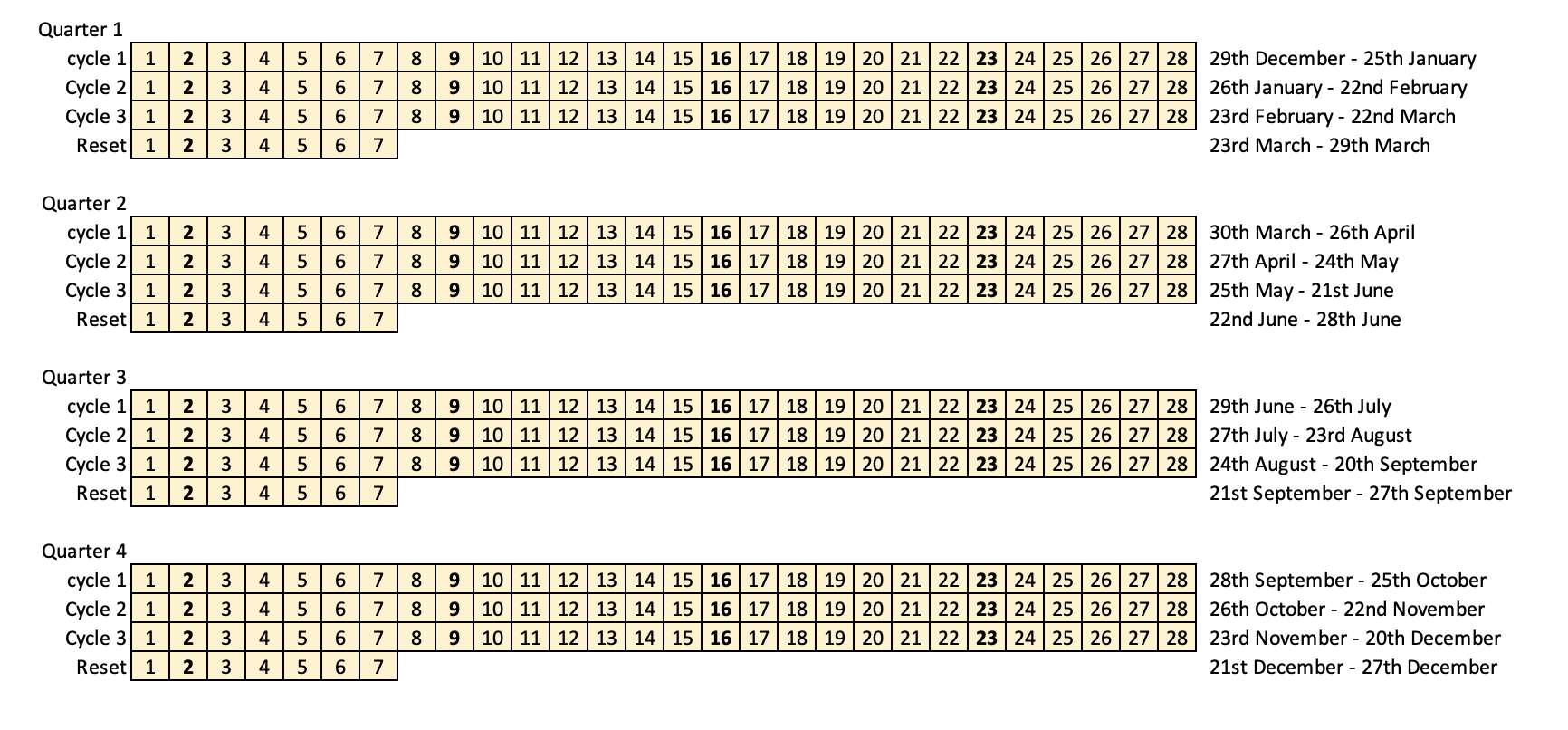
Instead of relying on the uneven nature of months, cyclic planning divides the year into:
4 quarters
Each quarter has 3 cycles (4 weeks each)
And a bonus “reset week”
That’s it. Simple. Neat. Same number of days. Same number of Mondays. Same number of everything.
This gives you:
a steady sense of time passing (which can help with time-blindness)
4 clear progress markers per cycle (because each week = 25%)
a predictable structure to build habits around
natural points for reflection, rest and resets
And because the cycles are always four weeks long, it’s easier to figure out what you need to get done each week to make progress on your goals.
So why now?
I came across the idea through, YouTuber Jashii Corrin, who explains cyclic planning beautifully and even created a free calculator to work out your cycle dates for the year. I’ve been following her for a while and she’s been doing cyclic planning for the past couple of years. Her recent video hit at the right time for me and was a real “ohhh… that makes sense” moment for me. This is what can make seasonal planning work more smoothly (because I never know when to currently add in the seasonal reflect and reset session in The Coaching Circle). If you want to explore it yourself, you can watch it here.
I’ve also been reading The 12 Week Year by Brian P. Moran and Mihael Lennington and having the shorter time frame means I’m less likely to put things of ‘until later’ because a year is ‘ages’. Together I felt they were telling me something.
How seasonal planning and cyclic planning fit together
This is the part that really clicked for me. I already work in seasons. The Coaching Circle already has seasonal goal setting and reflection sessions. My year already has these lovely, intentional pauses where I can check in with how things are going and get back on track. Cyclic planning simply gives me a cleaner structure inside those quarters.
So instead of “January, February, March”, I’ll have:
cycle 1 (4 weeks)
cycle 2 (4 weeks)
cycle 3 (4 weeks)
reset week
The Reset Week will allow me to:
clear my space (mentally and physically)
check in on my goals – are they still valid?
finish small loose ends (love a deadline)
prepare for the next quarter
It’s that “fresh slate” feeling, without the January pressure, plus I get to enjoy it 4 times a year, not just once.
How to get started:
If you’re curious about trying this alongside me next year, here’s the simple version:
Choose your start day. I’m going with Monday because it matches how I already plan, but Sunday works too.
Pick your first cycle start date. You can choose the first Monday of the year, or align it to a date that feels natural.
Use a cycle calculator. Jess’s free tool maps out every 4-week block and reset week for the whole year.
Decide on 2–3 focuses for the quarter. Keep it gentle. Keep it realistic.
Break those focuses down cycle by cycle. “What would 25% progress look like by the end of this week?” It’s a simple question, but incredibly useful.
Use the reset week for reflection, tidying and a calmer restart. No hustle. No rush. Just a chance to breathe and set yourself up well.
Why I’m sharing this now
The women I work with are busy. They’re caring for everyone else, juggling work, homelife, caring and more and often feel like life is happening to them rather than with them.
For me this approach feels more practical and kinder. It offers structure without pressure, progress without overwhelm, rhythms instead of rules.
And honestly? I think many of us could do with that.
If you’d like to watch the video that prompted me to have a go, then you can see it here and get access to her free calculator.
So, if you’re starting to think about how to plan 2026, I hope you’ll join me in giving this a go.
